
Where to Find Your First Customers: 10 Places for Customer Discovery
TL;DR
Your first customers are usually not waiting for your product launch.
They are already discussing their problems online.
The fastest way for early-stage founders to find users is not creating more noise, but discovering existing demand signals across communities like Reddit, Hacker News, Indie Hackers, forums, and niche groups.
This guide explains where customer conversations happen, how to identify high-intent users, and how founders can turn these conversations into their first customers.
Key Takeaways
- 42% of startups fail because there is no market need for their product. Customer discovery helps founders validate demand before spending months building.
- Potential customers usually talk about their problems, not your product category.
- The strongest customer signals often come from conversations like:
- "Is there a tool for this?"
- "How do you solve this problem?"
- "Any alternative to X?"
- Communities like Reddit, Hacker News, Indie Hackers, GitHub, and niche forums contain valuable early-user signals.
- Finding customers is not about reaching more people. It is about finding people who already have the problem you solve.
Building Is Easy. Finding Customers Is Still Hard.
Building products has never been easier.
With AI coding tools, no-code platforms, and open-source software, solo founders can launch products faster than ever before.
But one challenge remains:
How do you find your first customers?
Many founders spend weeks or months building a product, only to discover they don't know who actually needs it.
They ask:
- Where can I find my first users?
- How do I get early adopters?
- How do I validate my startup idea?
- How do I find people who need my product?
The traditional approach looks like this:
Build → Launch → Promote → Hope
But early-stage customer discovery works differently.
Your first customers are often already talking about their problems online.
They write:
"Is there a tool that can solve this?"
"I've tried several solutions, but none work."
"Does anyone know a better alternative?"
These conversations are customer signals.
The opportunity is not creating demand.
The opportunity is finding demand that already exists.

Why Customer Discovery Matters
According to CB Insights' analysis of startup failures:
42% of startups fail because there is no market need for their product.
Source: CB Insights — The Top 12 Reasons Startups Fail
https://www.cbinsights.com/research/startup-failure-reasons-top/
This means the biggest risk for early-stage founders is not building.
It is building something nobody urgently needs.
Customer discovery helps answer:
- Who has this problem?
- How painful is the problem?
- What solutions are people already using?
- Are users actively searching for alternatives?
Before trying to acquire customers, founders need to understand where demand already exists.
What Are Customer Signals?
Customer signals are conversations or behaviors that indicate someone has a problem, need, or buying intent.
| Signal | Example | Intent |
|---|---|---|
| Problem signal | "I struggle with..." | High |
| Alternative signal | "Any alternative to X?" | Very High |
| Recommendation signal | "What tool should I use?" | Extremely High |
| Complaint signal | "This product is too expensive." | High |
| Feature request | "I wish this had..." | Medium |
The strongest early customers are usually not people who see your advertisement.
They are people already looking for a solution.
Finding Where Customers Already Talk
The biggest mistake founders make is starting with promotion.
They think:
"How can I get more people to see my product?"
But early-stage growth usually starts with a different question:
"Where are people already talking about this problem?"
The internet is full of conversations where users describe:
- frustrations
- workflows
- missing solutions
- alternatives they are looking for
These conversations contain the exact language customers use.
That language is valuable for:
- product positioning
- content creation
- SEO strategy
- outreach
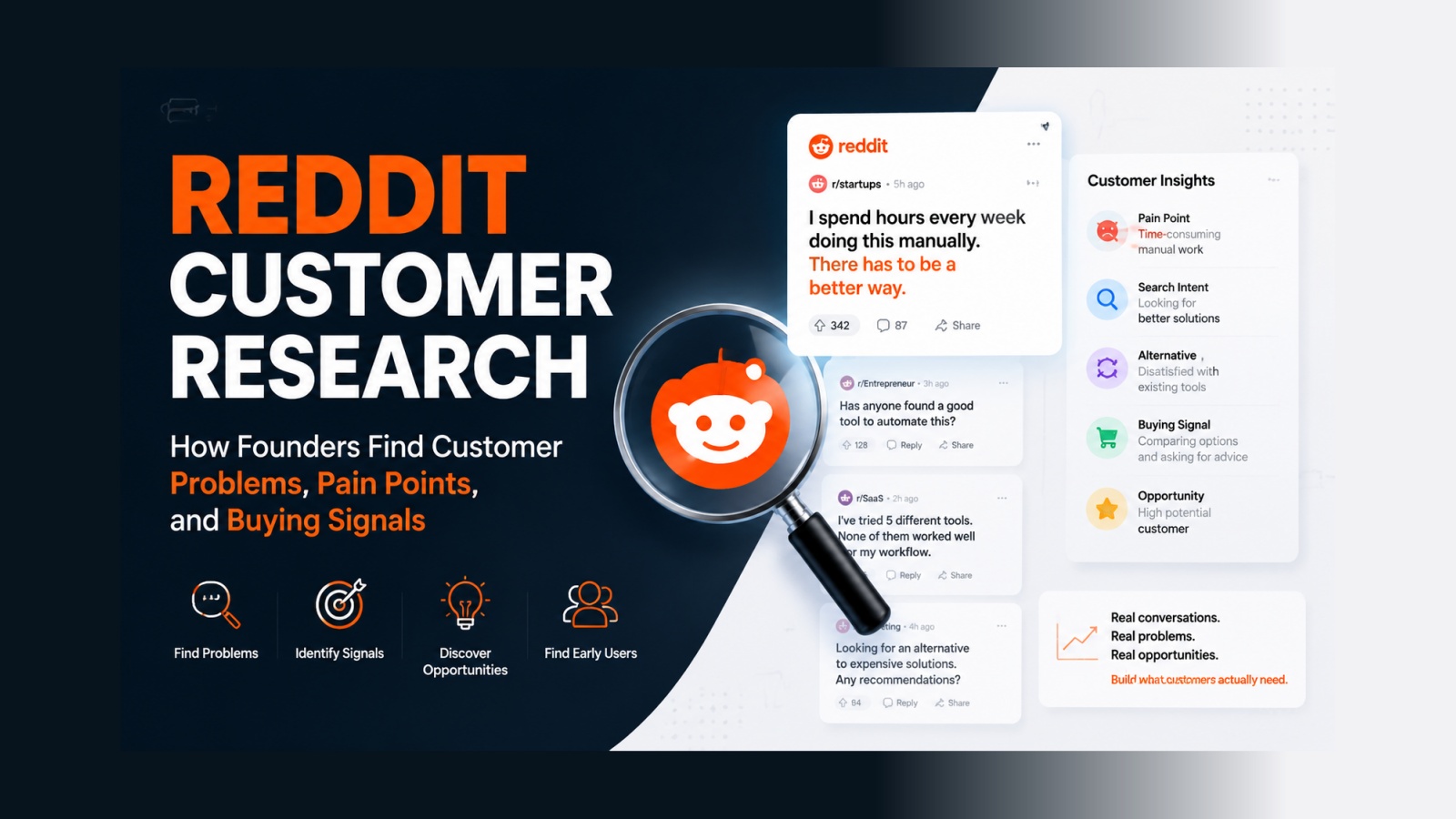
Reddit: Find Real Customer Problems
Reddit is one of the largest public sources of customer conversations.
People openly discuss:
- frustrations
- product recommendations
- workflows
- failed solutions
The mistake founders make is searching only for product keywords.
For example:
Searching:
"AI resume tool"
will mostly show competitors and existing products.
A better approach is searching for problems.
Examples:
"Why am I not getting interviews?"
"How can I improve my resume?"
"My resume gets rejected everywhere."
These users may not know your product exists.
But they already have the problem.
That makes them valuable potential customers.
Hacker News: Find Technical Early Adopters
For developer tools, APIs, and technical products, Hacker News is one of the best places to discover early users.
Developers often discuss:
- tools they dislike
- inefficient workflows
- missing features
- expensive alternatives
A comment like:
"I spend three hours every week doing this manually."
can reveal a real product opportunity.
The important part is not only looking at popular posts.
Often, the strongest customer signals are hidden inside discussions.
Look for:
- repeated complaints
- users asking for alternatives
- people sharing inefficient workflows
These conversations often reveal problems worth solving.
Indie Hackers: Discover Founder Problems
Indie Hackers is where many founders share real startup challenges.
Common discussions include:
- finding first customers
- SaaS marketing
- product validation
- growth problems
A founder saying:
"I built my SaaS but don't know how to get users."
is not just asking for advice.
They are describing a market problem.
These discussions can help you understand:
- what founders struggle with
- what solutions already exist
- where current products fail
Product Hunt Comments: Find Product Feedback
Many founders focus only on launching on Product Hunt.
But the comments often contain more valuable information.
Users frequently share:
- missing features
- buying objections
- competitor comparisons
- expectations
For example:
"This is useful, but I wish it supported..."
This type of feedback can reveal:
- unmet needs
- possible improvements
- new product opportunities
Customer research is often hidden inside product discussions.
Discord Communities: Find Conversations Search Engines Miss
Not every valuable customer conversation is indexed by Google.
Many niche discussions happen inside private or semi-private communities.
Examples:
- developer groups
- creator communities
- startup communities
- industry groups
People ask:
"Anyone know a tool for this?"
"How are you solving this problem?"
These conversations often show strong intent because users are actively trying to solve something.
The challenge is finding the right communities.
GitHub Issues and Discussions: Find Developer Pain Points
For technical products, GitHub is a powerful source of customer research.
Millions of developers share:
- bugs
- feature requests
- workflow problems
- discussions about alternatives
Look for:
- repeated issues
- users requesting specific features
- complaints about existing solutions
Repeated problems often become product opportunities.
Source: GitHub Octoverse
https://octoverse.github.com/
Facebook Groups and Niche Communities
Industry-specific communities can reveal highly focused customer problems.
Examples:
- ecommerce owners discussing sales challenges
- marketers discussing growth problems
- creators discussing content workflows
- developers discussing technical challenges
The goal is not immediate promotion.
The goal is understanding:
"What problem keeps appearing again and again?"
Repeated problems are often better signals than individual opinions.
YouTube Comments: An Underrated Research Source
YouTube comments are often overlooked.
Users frequently write:
"Is there an easier way?"
"This doesn't work for my situation."
"I wish this supported..."
These comments reveal:
- frustrations
- missing solutions
- user expectations
Tutorial videos, reviews, and comparison videos are especially valuable because viewers are already interested in solving a specific problem.
Industry Forums: Find Specific Problems
Niche forums often contain some of the highest-quality customer signals.
A person asking a detailed question usually has a real problem.
For example:
- business owners asking about operations
- developers asking about technical solutions
- creators asking about workflows
Specific problems are where many successful products begin.
AI Customer Discovery: Find Signals at Scale
The challenge today is not a lack of customer conversations.
The challenge is the amount of information.
Thousands of discussions happen every day across:
- forums
- communities
- social platforms
Manually searching everything does not scale.
AI customer discovery tools help founders identify:
- relevant discussions
- potential early adopters
- repeated pain points
- customer language
This changes the question from:
"Where should I advertise?"
to:
"Where are people already looking for solutions?"
This is the idea behind Agenmatic.
Agenmatic helps founders discover online conversations where potential customers are already discussing problems related to their products.
Instead of creating demand from zero, founders can start from existing demand signals.
Case Study: Finding Users for an AI Resume Builder
Finding customers is usually harder than building the product.
We experienced this ourselves.
While building an AI resume builder, we wanted to answer one question:
Who actually needs this product?
Instead of running ads first, we looked for people already discussing resume-related problems.
We searched conversations around:
- resume improvement
- job application struggles
- interview preparation
- resume feedback
- career tools
The goal was not finding people interested in "AI resume tools."
The goal was finding people experiencing the problem.
The Process
Step 1: Define the Target User
Identify people who were actively trying to improve their career opportunities.
Step 2: Find Problem Conversations
Look for users discussing:
- resume struggles
- job searching difficulties
- interview challenges
- career improvement
Step 3: Join Relevant Conversations
Instead of immediately promoting a product, participate in discussions where users already needed help.
Step 4: Collect Feedback
Use user responses to improve:
- product positioning
- messaging
- features
Results
| Metric | Result |
|---|---|
| Product | AI Resume Builder |
| Discovery method | Customer conversation research |
| First traffic | 200+ visits within 1 day |
| First conversion | Within 3 days |


The biggest lesson:
Early growth is not always about reaching more people.
It is about finding the right people.
How To Turn Conversations Into Your First Customers
Finding conversations is only the first step.
The goal is not sending spam or promoting everywhere.
A better process:
Understand Before Pitching
Before mentioning your product, understand:
- their problem
- their current solution
- their frustration
- what they have already tried
Good customer discovery starts with listening.
Provide Value First
Do not start with:
"Try my product."
Start with:
"Here is something that might help."
People are more willing to engage when the conversation is about solving their problem, not selling a product.
Turn Conversations Into Product Decisions
Customer conversations help you understand:
- who your real users are
- what problems matter most
- which features are valuable
- how to position your product
Customer research is not only for marketing.
It also improves the product itself.
Statistics & Data Points
Customer discovery is not just a startup strategy. Data shows why understanding users before building and scaling matters.
1. 42% of Startups Fail Because There Is No Market Need
According to CB Insights' analysis of startup failures:
42% of startups fail because there is no market need for their product.
This makes lack of market demand one of the biggest risks for early-stage founders.
Customer discovery helps reduce this risk by answering:
- Who actually has this problem?
- How painful is the problem?
- What solutions are users already trying?
- Are people actively looking for alternatives?
2. Reddit Contains Millions of Daily Customer Conversations
Reddit has more than 100 million daily active users, creating a massive amount of public conversations around:
- problems
- product recommendations
- frustrations
- alternatives
Many early customer signals appear in simple questions like:
"Is there a tool for this?"
"How do you solve this problem?"
"Any alternative to X?"
The challenge is not a lack of customer conversations.
The challenge is finding the conversations that show real intent.
Frequently Asked Questions
How do startups find their first customers?
Startups usually find their first customers through:
- online communities
- direct conversations
- referrals
- customer research
The key is finding people who already experience the problem your product solves.
How do I find early adopters before launching?
Look for communities where potential users discuss:
- problems
- frustrations
- alternatives
- workflows
Join those conversations before asking people to try your product.
What is customer discovery?
Customer discovery is the process of understanding potential users before scaling a product.
It helps founders validate:
- customer problems
- market demand
- product positioning
How do I find customer problems?
Look where people naturally discuss difficulties:
- forums
- communities
- product reviews
- social discussions
The best customer research often starts with listening.
Can I find customers without paid ads?
Yes.
Many startups find their first users through:
- communities
- content
- direct conversations
- customer research
Paid ads can increase reach, but they cannot replace understanding your users.
Your First Customers Are Already Talking
The internet is full of people describing problems.
The advantage does not come from shouting louder.
It comes from listening better.
Before spending money on ads, ask:
"Where are my future customers already talking?"
Because your first customers are probably not waiting for your launch.
They are already looking for a solution.
Find Customer Signals With Agenmatic
Discover conversations, problems, and communities where your future customers already exist.
Start discovering customer conversations →
Sources
-
CB Insights — The Top 12 Reasons Startups Fail
https://www.cbinsights.com/research/startup-failure-reasons-top/ -
Reddit Investor Relations
https://investor.redditinc.com/ -
GitHub Octoverse
https://octoverse.github.com/ -
Hacker News
https://news.ycombinator.com/ -
Product Hunt
https://www.producthunt.com/


✏️Leave a Comment