AI Intent Detection on Agenmatic — Understand Every Customer Intent in Milliseconds
Your customers don't speak in keywords — they speak in meaning. AI Intent Detection on Agenmatic uses advanced NLP and transformer models to classify every incoming message into the correct intent, regardless of phrasing, synonyms, or typos. Route support tickets automatically, trigger the right chatbot response, and power self-service workflows — all driven by accurate, real-time intent classification. Stop manual triage. Start intelligent routing. Use AI Intent Detection on Agenmatic and turn every conversation into a resolved outcome.
Core Features of AI Intent Detection on Agenmatic
AI Intent Detection on Agenmatic combines production-grade infrastructure with intelligent design — transformer-powered classification, confidence-aware fallback, and real-time analytics — to deliver an intent detection system that's accurate, reliable, and continuously improvable. Here are the three core capabilities that make AI Intent Detection the preferred choice for teams serious about conversational AI.
Transformer-Powered AI Intent Detection Classification Engine
AI Intent Detection on Agenmatic is powered by state-of-the-art transformer models — BERT-based classifiers, sentence-transformers, and hybrid LLM pipelines — that convert every message into a high-dimensional embedding vector. The classification layer scores these embeddings against your intent taxonomy with sub-millisecond latency. Whether you need a fast, deterministic classifier for high-volume routing or an LLM-based approach for zero-shot flexibility, AI Intent Detection delivers both in a unified, production-ready architecture.

Confidence Scoring and Intelligent Fallback in AI Intent Detection
Every AI Intent Detection classification on Agenmatic includes a confidence score. When confidence falls below your defined threshold, the system triggers a configurable fallback — asking the user to clarify, presenting likely options, escalating to a human agent, or falling back to RAG-powered knowledge retrieval. This confidence-aware design ensures your automation never acts on uncertain interpretations, maintaining trust and reducing costly misclassifications.

Real-Time AI Intent Detection Analytics and Monitoring
AI Intent Detection on Agenmatic generates a continuous stream of structured intent data that powers your operational intelligence. The analytics dashboard surfaces intent distribution trends, confidence score histograms, resolution rates per intent, and emerging topic alerts. Use this data to identify knowledge gaps, optimize your taxonomy, forecast support volume, and measure the ROI of your automation — all in real time, with exportable reports for cross-team visibility.

AI Intent Detection in Action — Real-World Classification Scenarios
AI Intent Detection adapts to every industry and conversation type. Whether you're handling high-volume support tickets, qualifying sales leads, or automating internal workflows, AI Intent Detection on Agenmatic captures the semantic nuance of your specific domain — from e-commerce returns to SaaS billing inquiries to healthcare appointment scheduling. No rigid rules. No brittle keyword lists. Just accurate intent understanding that scales with your business.

AI Intent Detection for Customer Support Triage
In customer support, speed and accuracy matter. AI Intent Detection on Agenmatic classifies incoming tickets by intent — billing question, technical issue, refund request, account change — and routes each one to the right team or automated workflow instantly. No more manual sorting. No more misrouted tickets. Your support team handles the right issues first, reducing resolution time and improving CSAT scores across every channel.

AI Intent Detection for Chatbot & Virtual Assistant Understanding
A chatbot that misunderstands is worse than no chatbot at all. AI Intent Detection gives your conversational AI the ability to truly understand user goals — not just match keywords. Whether a customer says 'where's my stuff,' 'has my parcel shipped,' or 'I need tracking info,' AI Intent Detection maps all three to the track_order intent and triggers the correct response flow. Build chatbots that actually resolve, not just deflect.

AI Intent Detection for Sales Lead Qualification
Not every inbound message is a support request — some are buying signals. AI Intent Detection on Agenmatic distinguishes between informational queries, pricing inquiries, demo requests, and ready-to-buy signals in real time. Route hot leads directly to sales, nurture warm prospects with targeted content, and let automation handle the rest. Turn every conversation into a qualified opportunity with intent-driven lead scoring.
Who Uses AI Intent Detection on Agenmatic — Industry Use Cases
From startups to enterprise contact centers, AI Intent Detection on Agenmatic powers smarter conversations across every industry. Discover how teams use intent classification to automate routing, improve resolution rates, and deliver better customer experiences at scale.

SaaS Companies and Tech Startups
For SaaS teams scaling support alongside user growth, AI Intent Detection on Agenmatic is a force multiplier. Classify onboarding questions, billing inquiries, bug reports, and feature requests automatically — routing each to the right team without manual triage. Startups use AI Intent Detection to maintain enterprise-grade support quality with lean teams, reducing escalation rates by up to 40% and keeping CSAT high as ticket volume grows.

E-commerce and Retail Brands
E-commerce support teams handle thousands of daily messages about order tracking, returns, exchanges, and shipping delays. AI Intent Detection on Agenmatic classifies each request instantly, triggering the appropriate automated workflow — pulling tracking info, initiating return labels, or escalating to a specialist when needed. Brands deploying AI Intent Detection resolve routine inquiries in seconds, not hours, dramatically improving customer experience while cutting support costs.

Financial Services and Insurance
In regulated industries, accurate intent classification is critical. AI Intent Detection on Agenmatic distinguishes between account inquiries, fraud reports, claims requests, and compliance questions — routing each to the appropriate team with full context preserved. Financial institutions use AI Intent Detection to meet SLA requirements, reduce misrouting errors, and ensure sensitive requests like fraud reports receive immediate priority handling.

Contact Centers and BPO Providers
High-volume contact centers deploy AI Intent Detection on Agenmatic to pre-classify every inbound interaction before it reaches an agent. By identifying intent, urgency, sentiment, and language upfront, AI Intent Detection enables intelligent routing that matches customers with the most qualified agent for their specific issue. BPO providers report 30%+ reductions in average handle time and significant improvements in first-contact resolution after implementing AI Intent Detection.
Why Choose AI Intent Detection on Agenmatic
Not all intent detection solutions are created equal. AI Intent Detection on Agenmatic combines deep semantic understanding, conversational configuration, full ecosystem integration, enterprise reliability, continuous learning, and measurable business impact — everything you need to turn unstructured customer messages into structured, actionable outcomes at scale.
AI Intent Detection with Deep Semantic Understanding
AI Intent Detection on Agenmatic doesn't match keywords — it understands meaning. Powered by transformer-based models and dense embeddings, the system recognizes that 'I want to stop my subscription,' 'cancel my plan,' and 'end my membership' all express the same intent. This semantic depth eliminates the brittle maintenance of keyword rules and delivers consistent accuracy across synonyms, typos, colloquial phrasing, and multilingual inputs.
Conversational AI Intent Detection Configuration
Forget about configuration screens and deployment pipelines. Using AI Intent Detection on Agenmatic is as simple as chatting with the AI Agent. Tell it your business context, define your intent categories in plain language, provide example phrases through natural dialogue, and test classification accuracy in real time. The AI Agent handles model training, embedding computation, and infrastructure scaling behind the scenes — you focus on the business logic, not the technical setup.
AI Intent Detection with Full Ecosystem Integration
AI Intent Detection on Agenmatic doesn't operate in isolation. Classified intents feed directly into your support workflows, chatbot response engines, analytics dashboards, and CRM systems. Route billing questions to your billing knowledge base, escalate cancellation requests to retention teams, trigger automated order lookups for tracking inquiries — all from a single intent classification layer that integrates with your existing stack via API.
AI Intent Detection with Enterprise-Grade Reliability
Production intent detection demands more than accuracy — it demands graceful degradation. AI Intent Detection on Agenmatic includes built-in confidence scoring, out-of-scope detection, and configurable fallback strategies. When the system can't classify with high confidence, it asks clarifying questions, escalates to humans, or falls back to RAG retrieval — never guessing incorrectly. Your customers always get appropriate responses, even on ambiguous inputs.
AI Intent Detection That Continuously Improves
Customer language evolves. New products create new issue types. Seasonal events introduce unfamiliar phrasing. AI Intent Detection on Agenmatic adapts continuously — monitoring confidence distributions, flagging emerging intents, and surfacing misclassifications for review. Add training examples, fine-tune thresholds, and expand your taxonomy without redeploying infrastructure. Your intent detection gets smarter every day, not less.
AI Intent Detection with Measurable Business Impact
Using AI Intent Detection on Agenmatic delivers quantifiable results: faster first-response times, lower escalation rates, higher first-contact resolution, reduced average handle time, and improved CSAT scores. Teams report 30–50% reductions in manual ticket triage and measurable improvements in agent productivity. AI Intent Detection doesn't just classify messages — it transforms your entire customer operations into a data-driven, automation-first engine.
AI Intent Detection Application Showcase — From Classification to Resolution
See how AI Intent Detection on Agenmatic transforms raw customer messages into structured, actionable outcomes across support platforms, self-service flows, analytics dashboards, and omnichannel deployments. Every classification drives a measurable business result.

AI Intent Detection Integration with Support Platforms
AI Intent Detection integrates seamlessly into your existing support stack. Whether you're running Zendesk, Intercom, Freshdesk, or a custom-built helpdesk, the intent classification layer plugs in via API and starts routing tickets by intent, urgency, and sentiment within minutes. Every classified message feeds your analytics pipeline — surfacing trending topics, knowledge gaps, and training opportunities in real time.

AI Intent Detection Powering Self-Service Automation
On Agenmatic, AI Intent Detection powers end-to-end self-service automation. When a customer asks 'how do I reset my password,' the intent classifier identifies password_reset, confidence scores above threshold, and the system executes the reset flow autonomously — no agent needed. Routine intents like order tracking, address updates, and subscription changes are resolved instantly, freeing your team to focus on complex, high-value conversations.

AI Intent Detection Analytics and Operational Intelligence
AI Intent Detection doesn't just classify — it generates operational intelligence. On Agenmatic's analytics dashboard, you see intent distribution over time, emerging topic trends, resolution rates per intent, and confidence score histograms. This structured data transforms unstructured conversation volume into actionable business insights — informing product decisions, content strategy, and support staffing with evidence instead of guesswork.

AI Intent Detection Across Omnichannel Customer Journeys
Enterprises deploy AI Intent Detection across multiple channels simultaneously — email, live chat, voice transcripts, social media, and in-app messaging. On Agenmatic, the same intent taxonomy works across all channels with consistent classification accuracy. Whether a customer tweets a complaint or emails a complex request, AI Intent Detection captures the goal and routes it appropriately — maintaining context and continuity across every touchpoint.
How to Use AI Intent Detection on Agenmatic — Three Simple Steps
Using AI Intent Detection on Agenmatic is conversational, not technical. There's no deployment or configuration — you work directly with the AI Agent to define intents, test classification, and start routing customer messages automatically. Follow these three steps to get started.
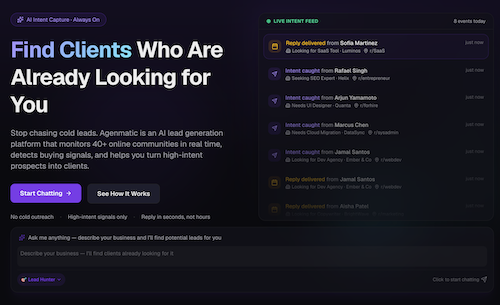
Define Your Intent Taxonomy with the AI Agent
Start by telling the AI Agent what your customers typically want to accomplish. Describe your intent categories in plain language — things like check_order_status, request_refund, or schedule_appointment. Provide example phrases for each intent, covering different ways customers might express the same goal. The more diverse your examples, the more accurately AI Intent Detection will classify real conversations. Most teams define their first 15–20 intents within minutes.
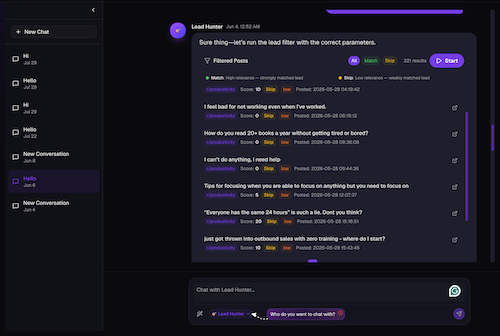
Test and Refine Classification Rules
Once your intents are defined, test them with real customer messages. The AI Agent shows you how it classifies different inputs and the confidence scores for each classification. If you find edge cases or misclassifications, simply tell the AI Agent what went wrong and it adjusts the rules. Set confidence thresholds — for example, only auto-route when confidence exceeds 85% — and define fallback actions for uncertain cases. You're building the logic through conversation, not configuration screens.
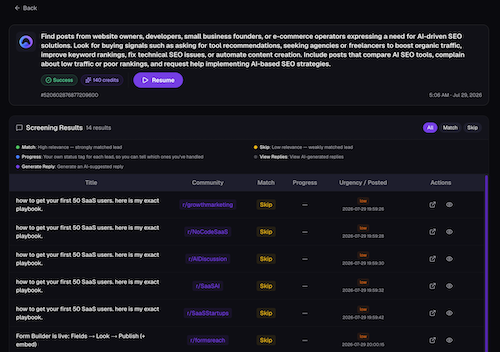
Use AI Intent Detection in Your Workflows
Once configured, AI Intent Detection automatically classifies every incoming customer message in real time. Monitor intent distribution, confidence scores, and resolution rates through the dashboard. When you spot new intents or classification issues, just tell the AI Agent — it refines the model instantly without any technical changes. The system learns and improves as your business evolves.
Frequently Asked Questions
Everything you need to know about AI Intent Detection — from how it works and how accurate it is, to real-world use cases, multilingual support, and how to use it on Agenmatic. Get clear, expert answers to the top 10 questions businesses ask about AI intent detection.
AI Intent Detection is a Natural Language Processing (NLP) task that identifies the underlying goal behind a user's message by classifying it into a predefined intent category. Instead of matching exact keywords, AI Intent Detection uses transformer-based models and embeddings to understand semantic meaning — so 'cancel my plan,' 'I want to stop my subscription,' and 'end my membership' are all correctly mapped to a single cancel_subscription intent. This enables chatbots, support systems, and AI agents to respond accurately regardless of how a customer phrases their request.
AI Intent Detection works through a multi-stage pipeline: first, the input text is preprocessed and tokenized; then a transformer encoder (such as BERT or a fine-tuned large language model) converts the text into a dense embedding vector that captures its semantic meaning. A classification layer scores the embedding against all known intents, assigns a confidence score, and triggers the corresponding action — routing to the right knowledge base, executing a workflow, or escalating to a human agent when confidence falls below a defined threshold. Modern systems also combine fast classifiers with LLM-based understanding for hybrid accuracy and flexibility.
AI Intent Detection and intent recognition refer to the same core NLP task — identifying what a user wants to accomplish from their input. Some practitioners draw a subtle distinction: intent detection focuses on the binary step of confirming whether a recognizable intent exists, while intent recognition classifies which specific intent is present. In practice, modern AI Intent Detection systems handle both within a single pipeline, making the terms interchangeable in most product and engineering contexts.
Modern AI Intent Detection systems powered by transformer models and LLMs routinely achieve 95%+ accuracy on well-defined intent taxonomies — far surpassing older keyword-matching approaches that typically plateau around 70–80%. Accuracy depends on the quality of the intent taxonomy, the diversity of training examples, and the robustness of the out-of-scope detection layer. On Agenmatic, AI Intent Detection continuously learns from your conversation data, improving classification accuracy as your intent coverage expands.
AI Intent Detection is the backbone of intelligent customer support. It powers automated ticket triage and routing — classifying each incoming request by intent, urgency, and sentiment before sending it to the right team. It enables chatbots and virtual assistants to understand user goals and respond with relevant answers instead of generic replies. It drives self-service automation for routine tasks like password resets, order tracking, and refund processing. And it feeds analytics dashboards with structured intent data so teams can identify trending issues, knowledge gaps, and training opportunities.
Yes. AI Intent Detection on Agenmatic supports multilingual classification out of the box. Transformer-based models encode semantic meaning across languages, so an intent taxonomy defined in English can correctly classify equivalent expressions in French, Spanish, German, Japanese, and more — often without requiring separate training data per language. For markets with specific linguistic nuances, you can fine-tune the detection layer with localized examples to further improve accuracy.
Entity extraction and AI Intent Detection are complementary tasks that typically run in parallel within an NLU pipeline. Intent Detection answers 'what does the user want?' — for example, tracking an order. Entity extraction answers 'what specific details are mentioned?' — for example, the order number, date, or product name. In the message 'track order 4821,' AI Intent Detection identifies the track_order intent while entity extraction captures 4821 as the order ID. Together, they give the system everything needed to take the correct action.
Using AI Intent Detection on Agenmatic is straightforward: simply start a conversation with the AI Agent and describe your intent taxonomy based on your top support topics, provide representative example phrases for each intent, and the system handles the rest. You can test classification accuracy, monitor confidence scores, and refine your taxonomy through natural dialogue — no configuration screens or deployment pipelines required. Most teams validate their first 15–20 intents within minutes of starting a conversation.
When AI Intent Detection cannot classify a message with sufficient confidence, the system triggers a fallback strategy instead of guessing. Common fallback actions include: asking the user to rephrase or clarify their request, presenting a short list of likely intents to choose from, escalating the conversation to a human agent with full context preserved, or falling back to a retrieval-augmented generation (RAG) search across your knowledge base. The goal is to never give a confidently wrong answer — graceful degradation is a core design principle of AI Intent Detection on Agenmatic.
The biggest advantage of AI Intent Detection over keyword matching is semantic generalization. Keyword rules break when customers use synonyms, typos, or unfamiliar phrasing — a rule-based system matching 'cancel appointment' will miss 'call off my booking.' AI Intent Detection uses embeddings that understand meaning, so it correctly maps 'I don't want this anymore,' 'take me off the plan,' and 'please terminate my account' to the same cancel_subscription intent without any manual rule updates. This dramatically reduces maintenance burden while improving accuracy and coverage.
Explore More
Discover related features and pages to enhance your workflow
More Features
AI Intent Detection on Agenmatic — Turn Every Customer Message into a Precise Action
Stop guessing what your customers mean. AI Intent Detection on Agenmatic classifies every incoming message — from refund requests to product inquiries — into the correct intent in milliseconds. Route conversations to the right agent, trigger the right workflow, and resolve issues faster — all without manual triage. Experience smarter support flows with AI Intent Detection on Agenmatic today.